

Written by Malcolm Yeo. Edited by Nick T.
There is a particular type of smugness that belongs exclusively to full EV owners. You know the type. They talk about “range” the way other people talk about their cholesterol — frequently, unprompted, and with the quiet anxiety of someone who has done the calculations and found them wanting. They plan road trips around charging stops with the precision of a military logistics operation. They arrive at dinner parties fifteen minutes late because the fast charger on the expressway was occupied. They are, technically speaking, the future of motoring. But the future, it turns out, is quite stressful.
Enter the 2026 BYD Seal 6 DM-i. A car that looks at the full EV lifestyle, considers it carefully, and politely suggests there might be a better way.
Two Thousand Kilometres. Read That Again.
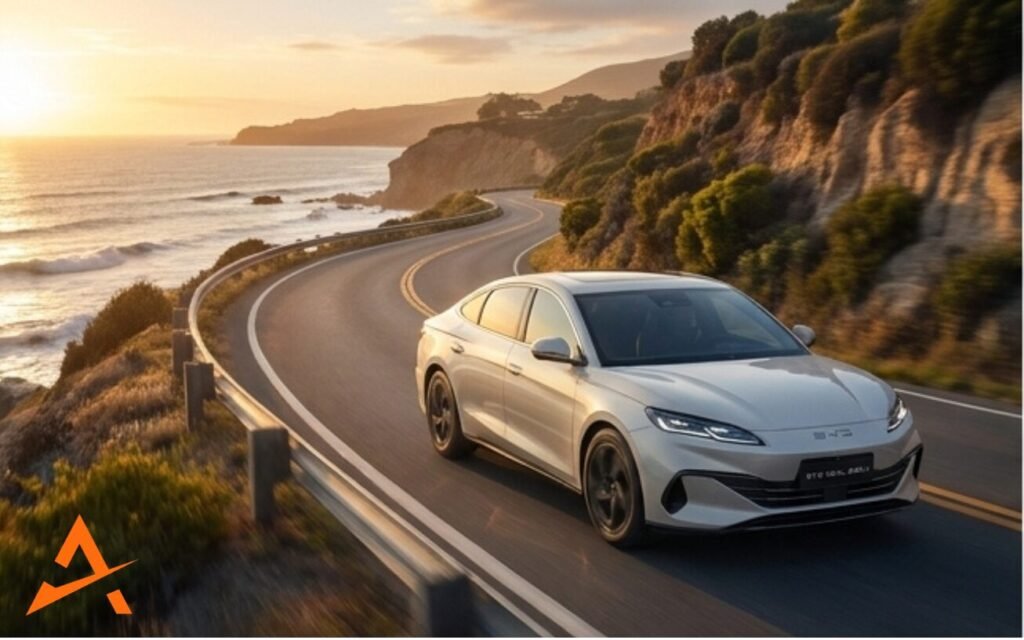
The headline claim of the Seal 6 DM-i is so absurd that I initially assumed it was a typo. A combined range of over 2,000 km on a single charge and a full tank of petrol. Under CLTC testing conditions, yes — and real-world numbers, as Autocar found, land somewhere around 939 miles in everyday driving, which is still enough to drive from Singapore to Kuala Lumpur and back approximately three times before you need to stop for anything other than food, coffee, or an existential crisis.
The secret is BYD’s DM 5.0 hybrid technology, which pairs a 1.5-litre petrol engine — running at a world-record thermal efficiency of 46.06%, which means it converts more fuel into actual forward motion than any other production engine on the planet — with a high-efficiency electric motor. The result is a car that achieves 2.9L/100km fuel consumption even when the battery is completely flat. That’s not a misprint either. That is, for context, more efficient than a Toyota Prius driven downhill by someone with exceptional posture.
The Case Against Full EVs (That Nobody Says Out Loud)
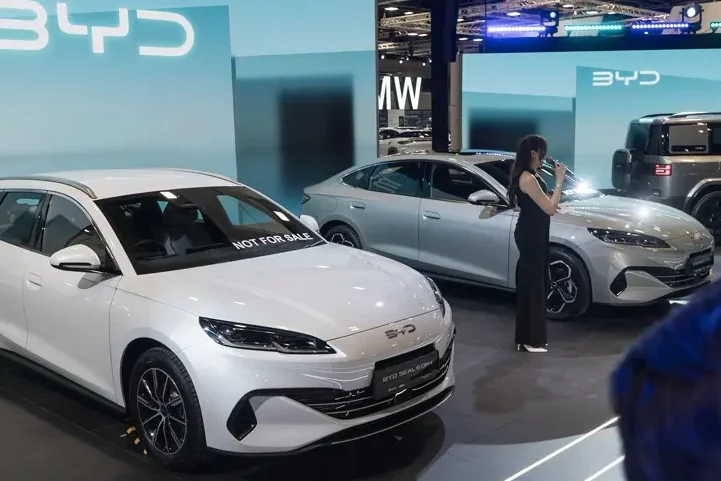
For Singaporean drivers, the 80 to 120 km of pure electric range covers virtually every daily commute without ever waking the petrol engine. The city running is silent, smooth, and practically free. Then, when the weekend arrives and someone suggests a drive up to Penang, you simply… go. No spreadsheet required.
The honest truth about full EVs — and nobody in the industry likes to say this clearly — is that they work brilliantly for about 90% of what most people do, and cause mild-to-moderate panic for the other 10%.
That 10% is the long drive. The spontaneous road trip. The moment you realise the charging station you planned to use is out of service, occupied, or charging at 22kW when you were promised 150kW. It is the 21-minute fast charge that somehow becomes 45 minutes because the network is congested. It is the quiet, creeping awareness, somewhere around Yong Peng, that you might not make it.
The Seal 6 DM-i eliminates all of that entirely. You charge it at home when it’s convenient. You drive the first 80-odd kilometres on electricity, costing pennies. When the battery runs low, the petrol engine steps in — quietly, efficiently, and without drama. Autocar notes that when the engine does engage, it does so “with impressively little fanfare,” which is more than can be said for most of the life events that ruin a perfectly good Tuesday.
It is, in short, the practical argument for electrification that the full EV lobby has been struggling to make for years. BYD just made it with a 65-litre fuel tank.
Inside: More Screen Than You Strictly Need, But You’ll Want It Anyway
The interior of the Seal 6 DM-i is where Chinese ambition and European convention meet for an occasionally awkward conversation.
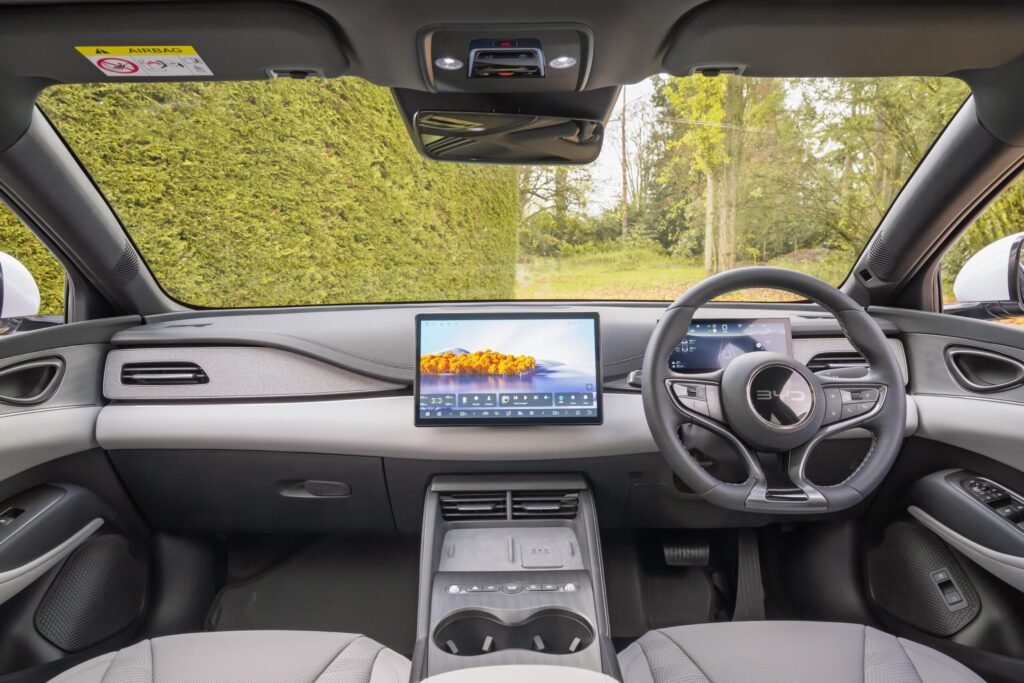
The headline feature is a 15.6-inch touchscreen — fixed in place now, the rotating screen having been quietly retired after customer feedback revealed that most people found it bewildering rather than clever. It is large. Impressively large. Almost confrontationally large. It handles navigation, climate, audio, and a suite of driver assistance settings, all with the quick, responsive interface that BYD describes as evidence that it is, at heart, a technology company that happens to make cars.
The cabin itself is pleasant enough — vegan leather, ambient lighting in the Comfort spec, and a flat floor in the rear that gives back-seat passengers the sort of legroom usually reserved for business class. Reviewers at Driven noted that even with a tall driver up front, rear passengers had a generous four inches of knee clearance. In a family car, this matters considerably more than most people admit until they’ve done a three-hour drive with a six-foot relative directly in front of them.
That said, get close enough and a few realities assert themselves. The column stalk and drive selector are made from plastics that don’t quite match the ambition of everything else, and the front seat cushions are a touch flat for longer journeys. These are not dealbreakers. They are small reminders that the Seal 6 DM-i is priced aggressively for a reason, and that reason is not because BYD forgot to add anything.
The Ride: One Area Where Pragmatism Has Its Limits
Here is where honesty demands a gentle but clear word of warning.
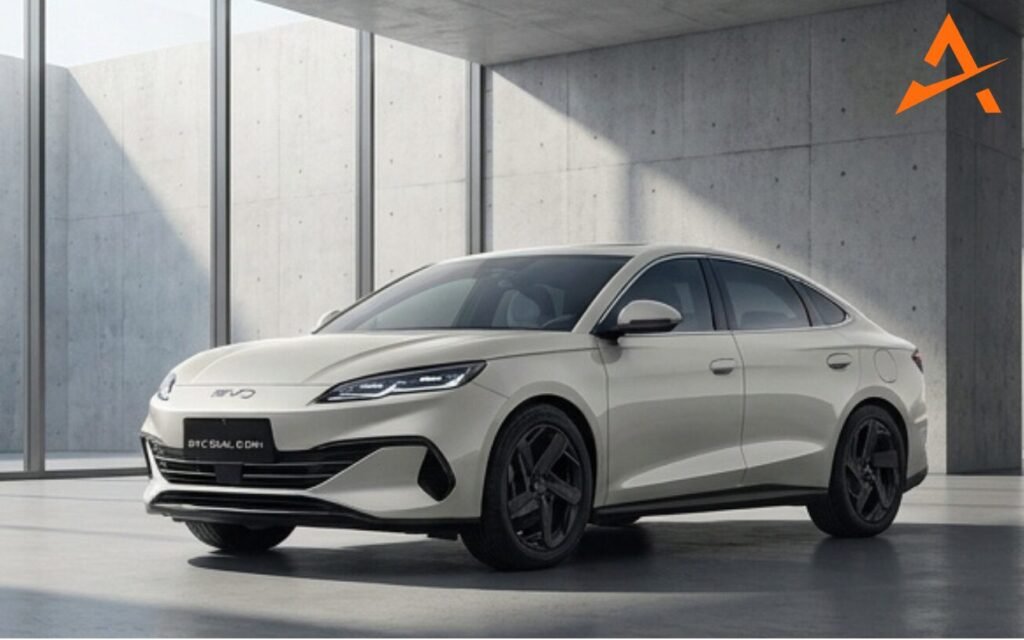
The Seal 6 DM-i does not ride well. Multiple reviewers across Autocar, Top Gear, and Business Car noted the same thing independently: the suspension, particularly on the smaller-wheeled Boost trim, is too stiff for a car positioned as a long-distance grand tourer, and has a tendency to shuffle and jostle its occupants over imperfect road surfaces. Which is to say – all road surfaces.
The steering is light, which is comfortable at low speeds and rather anonymous at higher ones. It does not communicate the road to your hands so much as quietly suggest that a road exists somewhere below you and is probably fine.
None of this is unusual for a family PHEV in this price bracket — most rivals have similar compromises somewhere in the package. But it does mean that if you’re expecting the driving refinement of a Honda Accord or the composed ride of a Toyota Camry Hybrid, you may need a moment to recalibrate expectations.
The powertrain, at least, more than compensates. Smooth, seamless, and surprisingly EV-like even in hybrid mode — it is the undisputed highlight of the entire ownership proposition.
The Verdict: The Sensible Choice, Dressed Up as an Exciting One
The BYD Seal 6 DM-i is not glamorous. It will not make strangers turn and stare the way a Porsche might, nor will it produce the kind of effortless performance that makes you feel like a better driver than you are. What it will do is cover 2,000 km between fill-ups, cut your daily fuel costs to something approaching negligible, carry four adults in genuine comfort, and make the eternal question of “but what about range anxiety?” entirely moot.
For Singapore specifically, the logic is almost embarrassingly straightforward. Use it as an EV in the city — where it is quiet, efficient, and costs almost nothing to run. Use the petrol engine for the occasional cross-border run where charging infrastructure becomes someone else’s problem. Drive past every charging station with the quiet satisfaction of someone who planned ahead.
Full EV owners will tell you the future belongs to them. They are probably right. But the future, at least for now, still has a petrol tank — and in the Seal 6 DM-i, it is an exceptionally good one.
The BYD Seal 6 DM-i is now available in Singapore.
At the time this article was written, the Seal 6 DM-i 1.5 Dynamic (Sedan) is available at SGD $188,888 whilst the Seal 6 DM-i 1.5 Premium (Sedan) version is available at SGD $196,888.
For current pricing and to book your test drive, visit www.byd.com/sg .